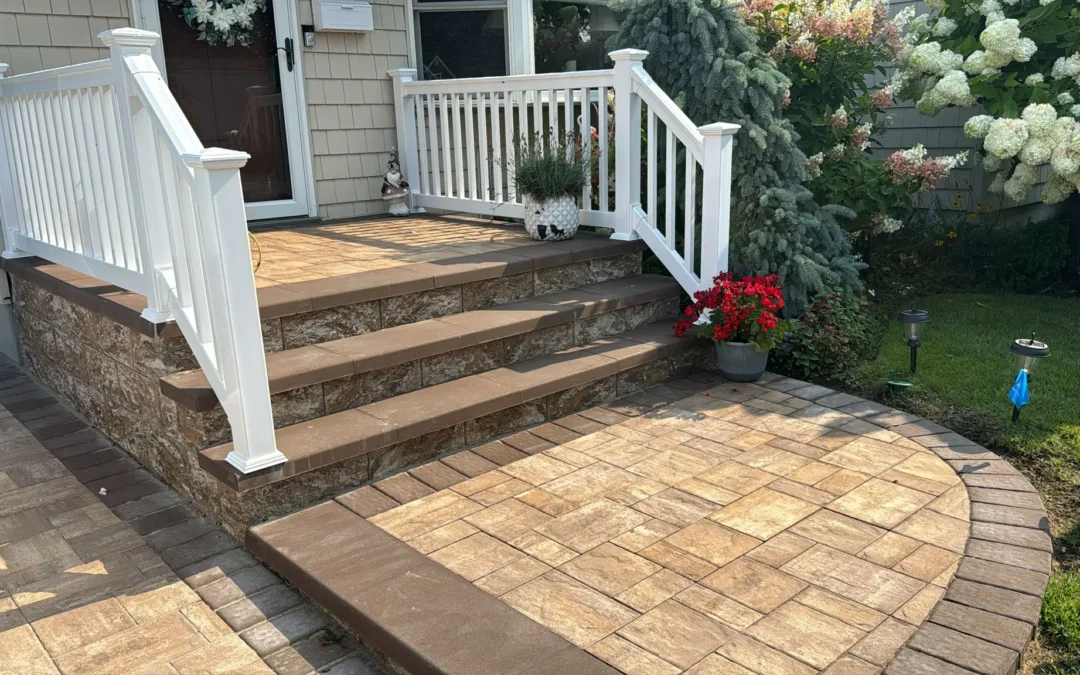
Good masonry should do more than look attractive on installation day. A patio, walkway, stoop, set of steps or retaining wall must remain stable, drain correctly and fit naturally with the surrounding property.
Choosing masonry contractors in Suffolk County therefore requires careful attention to preparation, materials, workmanship and local conditions. Long Island’s rainfall, winter temperatures and seasonal ground movement can quickly expose weak foundations, poor drainage or unsuitable installation methods.
Here is what homeowners should understand before requesting estimates or approving masonry work.
TL;DR
- Masonry includes patios, walkways, stoops, steps, retaining walls and other structures built with materials such as concrete, brick, pavers and stone.
- Material choice should reflect the structure’s purpose, appearance and maintenance requirements.
- Base preparation and drainage are just as important as the visible stone or pavers.
- Existing cracks, movement or water problems should be investigated before repairs begin.
- Ask for a written scope covering preparation, materials, drainage, removal and clean-up.
- Retaining walls and other structural work may require additional design or approval.
- Shore 2 Shore provides paving and masonry services from East Setauket across Suffolk County.
What Services Do Masonry Contractors Provide?
According to the US Bureau of Labor Statistics, masonry professionals work with brick, concrete, concrete block and natural or manufactured stone to build structures. For residential properties, the work commonly combines practical construction with exterior design.
Typical masonry projects include:
- Patios
- Garden paths and walkways
- Front stoops
- Outdoor steps
- Retaining walls
- Concrete paving
- Paver installations
- Stone borders
- Masonry repairs
- Driveway borders and aprons
- Outdoor living surfaces
Shore 2 Shore Stonework & Asphalt provides paving and masonry services throughout East Setauket and Suffolk County, including patios, walkways, stoops, steps, concrete surfaces and retaining walls.
Why Local Masonry Experience Matters
Masonry is exposed to water, vehicle or foot traffic, temperature changes and movement in the surrounding ground. A detail that appears minor during construction can become a visible defect after repeated seasonal changes.
Local contractors should understand how to plan for:
- Freeze-and-thaw cycles
- Surface and subsurface drainage
- Soil and base stability
- Changes in property elevation
- Connections to driveways and building entrances
- Safe step heights and walkway transitions
- Material movement and joint placement
- Water travelling towards foundations or basements
For example, a patio should not direct water towards the house. A walkway should have a stable, even transition between surfaces. A retaining wall needs suitable drainage behind it so water pressure does not build up unnecessarily.
Which Masonry Material Should You Choose?
The best material depends on where it will be installed and what the area needs to do.
Concrete pavers
Pavers are widely used for patios, walkways and driveway borders because they are available in different colours, sizes and patterns.
Advantages may include:
- Flexible design choices
- Defined patterns and borders
- The ability to replace individual units
- Suitability for patios and pedestrian routes
- Compatibility with different property styles
However, the appearance will only remain consistent when the base, bedding layer, edge restraints and joints are properly completed.
Natural stone
Natural stone can create a distinctive, high-end appearance. Because colour, thickness and texture can vary, it requires careful selection and installation.
It may suit:
- Feature patios
- Traditional or natural-looking landscapes
- Garden paths
- Steps and borders
- Properties where individual character is preferred
Ask how the installer will manage variations in stone thickness, joint width, drainage and slip resistance.
Brick
Brick offers a traditional appearance and can be used for paths, edging, steps and decorative elements. The selected product should be suitable for its location and exposure.
Brickwork depends on accurate alignment, suitable mortar or bedding methods and correctly finished joints.
Poured concrete
Concrete can provide a strong, practical surface for paths, patios and other exterior areas. Finish choices may include smooth, textured or decorative treatments.
Correct base preparation, placement, joint planning and curing remain essential. See Shore 2 Shore’s concrete paving services for relevant options.
Manufactured stone and concrete products
Manufactured materials can provide a consistent appearance and a broad selection of styles. The product should be chosen for its intended use, whether structural, load-bearing, decorative or a surface veneer.
Masonry planning note: Select a material because it suits the structure and property, not simply because it looks attractive in a catalogue. A suitable product installed on a well-prepared base will generally provide better value than a premium finish placed over poor groundwork.
What Proper Masonry Installation Should Include
Although the process varies by project, professional masonry work usually begins long before the first visible stone or paver is installed.
Site inspection
The contractor should assess:
- The proposed dimensions and layout
- Existing slopes and elevation changes
- Soil and ground conditions
- Nearby foundations or walls
- Drainage routes
- Access for materials and equipment
- Connections to existing surfaces
- How the completed area will be used
Excavation
The area may need to be excavated to create space for the appropriate base and finished material. The required depth will depend on the application, material and site conditions.
Base installation and compaction
The base provides the main support for the structure or surface. Insufficient depth, weak material or poor compaction can contribute to settlement and uneven areas.
The contractor should explain:
- What base material will be used
- How the base will be installed
- How it will be compacted
- Whether unstable areas require extra work
- How the base relates to the finished elevation
Drainage and grading
Water must be considered during the design stage. Otherwise, the completed project could transfer water towards a building, cause pooling or contribute to movement.
Drainage planning may involve:
- Establishing an appropriate surface slope
- Directing runoff away from the home
- Installing drainage behind retaining walls
- Coordinating with existing drains
- Maintaining suitable finished heights near doors and foundations
Edge support and joints
Paver installations usually require effective edge restraints. Mortared structures require properly planned and finished joints. Movement and control joints may also be relevant to concrete work.
Finishing and clean-up
The contractor should remove construction waste, inspect transitions and explain any curing, sealing or initial maintenance requirements.
Patios: Creating a Stable Outdoor Living Area
A patio provides space for seating, entertaining and everyday outdoor use. Its design should consider more than the surface pattern.
Before installation, decide:
- How much furniture the patio must accommodate
- Whether space is required for a barbecue or outdoor kitchen
- How people will travel between the home, garden and driveway
- Whether the surface needs to meet a doorway
- Where rainwater will travel
- How the patio will connect with landscaping
Shore 2 Shore offers patio installation using options such as pavers, natural stone and concrete.
Walkways: Balancing Appearance and Safe Access
An uneven or poorly positioned walkway can become difficult to use, especially near steps, driveways and entrances.
A professional walkway should consider:
- Comfortable width
- Predictable changes in level
- Stable edges
- Suitable surface texture
- Drainage
- Lighting and visibility
- Connections with other surfaces
View the company’s walkway services if you are planning a front path, side access route or garden walkway.
Stoops and Steps: Where Precision Matters
Stoops and steps must provide stable, comfortable access. Irregular heights, loose material or deteriorated joints can create safety concerns.
Before approving work, discuss:
- The planned rise and depth of each step
- Handrail requirements
- The landing size
- Material and finish
- Drainage near the entrance
- Connections to the walkway
- Whether the existing structure can be repaired
Shore 2 Shore installs stoops and steps and also provides stoop and step repairs where replacement is unnecessary.
Retaining Walls: More Than a Decorative Feature
Retaining walls hold back soil and can help manage slopes or create usable levels. Because they interact with soil and water pressure, they should not be treated as ordinary garden borders.
A retaining wall project may require consideration of:
- Wall height
- Soil conditions
- Drainage behind the wall
- Surcharge from driveways or structures
- Footing or base requirements
- Geogrid or other reinforcement
- Local permission or engineering requirements
The need for professional design or approval depends on the wall’s location, dimensions and function. Discuss these requirements before construction begins.
Learn more about Shore 2 Shore’s retaining wall services.
Should Damaged Masonry Be Repaired or Replaced?
Repair may be appropriate when the problem is localised and the main structure remains stable. Examples include isolated joint deterioration, a limited number of loose pavers or minor surface damage.
Replacement or reconstruction may be required when:
- Large areas are sinking
- A wall is leaning or bulging
- Steps have become unstable
- Cracking is widespread
- Water is repeatedly collecting
- The base has failed
- Previous repairs are separating
- The existing layout creates a safety problem
Cracks and movement can sometimes indicate water, drainage or foundation issues. Treating the visible defect without correcting its cause may only provide a temporary improvement.
If the problem affects a foundation or the surrounding ground, Shore 2 Shore also provides repair services and waterproofing solutions.
How to Compare Masonry Contractors
A detailed estimate should make it easier to compare the proposed quality, not just the final price.
Ask each contractor:
- What preparation and excavation are included?
- Which materials and products will be used?
- How will the base be constructed?
- How will drainage be managed?
- Are edge restraints, joints and finishing included?
- Who will remove the old material and waste?
- Are permits or approvals likely to be required?
- How long should the work take?
- What could alter the quoted price?
- What maintenance will the finished work need?
- Can I see comparable completed projects?
- Will the complete scope be provided in writing?
Shore 2 Shore’s gallery includes examples of patios, walkways, stoops, steps, paver driveways and asphalt work completed for local properties.
Common Masonry Mistakes to Avoid
Choosing by price alone
A cheaper estimate may exclude adequate excavation, base depth, drainage or finishing. Compare the complete scope before deciding.
Ignoring drainage
Water can cause staining, joint deterioration, settlement and soil movement. Drainage should be part of the initial design.
Installing over unstable surfaces
Covering a moving or badly deteriorated area rarely corrects the underlying problem.
Selecting the wrong material
Not every decorative material is suitable for steps, vehicle loads or frequently wet areas. Match the product to its use.
Overlooking transitions
Abrupt changes between a path, driveway, patio or entrance can look unfinished and may create a trip hazard.
Repairing symptoms without finding the cause
Repeated cracking or displacement often indicates a deeper problem involving the base, soil, water or structure.
Frequently Asked Questions
What projects can masonry contractors complete?
Residential masonry contractors may construct patios, walkways, stoops, steps, retaining walls, concrete surfaces, paver areas, stone borders and related exterior features. Some also provide repairs and restoration.
How long does a masonry project take?
A small walkway or repair may take several days, while a large patio, complex stoop or retaining wall can take longer. Excavation, weather, material availability, curing and project complexity can all affect the schedule.
What is the best material for a patio?
Pavers, natural stone and concrete can all perform well when properly selected and installed. Pavers offer design flexibility, natural stone provides individual character, and concrete creates a practical continuous surface.
Why are my patio pavers sinking?
Pavers may sink because of inadequate base preparation, poor compaction, drainage problems, edge failure or disturbance below the surface. The cause should be corrected before the pavers are reset.
Can masonry work be completed during winter?
Some work may be possible during colder periods, but temperature, moisture and ground conditions can restrict installation. Mortar and concrete products also have specific application and curing requirements.
Does a retaining wall need drainage?
Most retaining walls need an appropriate method of relieving water pressure behind the structure. The exact drainage design depends on the wall, soil and site conditions.
Do masonry projects require permission?
Requirements depend on the project type, dimensions and location. Larger retaining walls, structural work and projects near boundaries or public areas may require permits or professional design. Confirm applicable local requirements before work begins.
Where does Shore 2 Shore provide masonry services?
The company serves East Setauket and communities across Suffolk County and Long Island, including Smithtown, Brookhaven, Ronkonkoma, Centereach, Patchogue, Medford, Sayville, Huntington, Islip and surrounding areas.
Request a Masonry Estimate in Suffolk County
The best masonry projects combine suitable materials with careful preparation, stable support and effective drainage. Before selecting a contractor, request a clear explanation of how the complete project will be constructed.
Contact Shore 2 Shore Stonework & Asphalt for a free masonry estimate in East Setauket or elsewhere in Suffolk County. You can also call (516) 989-6545 to discuss your project.
The service descriptions and internal links above were checked against Shore 2 Shore’s current Driveways, Paving & Masonry and Our Services pages. The trade description is supported by the US Bureau of Labor Statistics.