
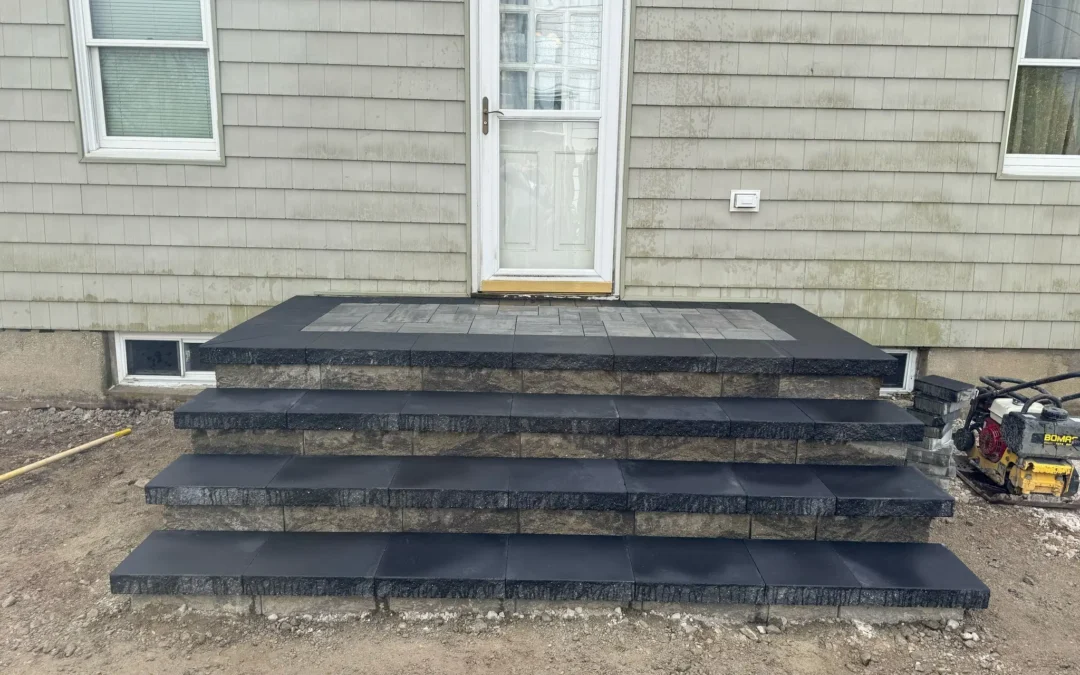
The front stoop gets more daily use than almost any other part of a house, and it’s also exposed to more freeze-thaw cycling, foot traffic, and weather than most other exterior features. So it’s not surprising that stoop steps are often one of the first things to show real wear. The question homeowners usually come to us with isn’t whether something needs to be done, it’s whether a repair will actually hold, or whether it’s time to replace the steps entirely.
Getting this right matters because a stoop isn’t just cosmetic. It’s a structure people use, often carrying groceries, kids, or simply not paying close attention, multiple times a day.
What causes stoop steps to crack or become uneven?
Freeze-thaw damage. Water that gets into small cracks or pores in concrete expands when it freezes, widening existing cracks and creating new ones over successive winters. This is one of the most common causes of visible cracking in older concrete steps across Long Island.
Settling. If the ground or fill material beneath the steps wasn’t properly compacted when they were built, or has shifted since, the whole structure can settle unevenly, leading to steps that are no longer level or that have separated slightly from the house.
Detachment from the house. A stoop that was built as a separate structure attached to the foundation can, over time, pull away slightly as it settles independently of the house itself. This often shows up as a visible gap between the top step and the doorway threshold.
Surface wear and spalling. Years of foot traffic, de-icing salt, and weather exposure can cause the surface layer of concrete to flake or wear away, known as spalling, which affects appearance and can create a rougher, less safe walking surface even if the structure underneath is sound.
How to tell if it’s a repair or a replacement situation
A few cracks that are purely cosmetic, not affecting the level or stability of the steps, are often good candidates for a straightforward repair: patching, resurfacing, or crack sealing, depending on the extent.
Steps that are noticeably uneven, where one step sits at a different height or angle than it should, are a bigger concern, both structurally and from a safety standpoint. Uneven risers are a genuine trip hazard, and if the unevenness is the result of the whole structure settling, patching the surface won’t correct the underlying lean or slope.
A visible gap between the stoop and the house, particularly one that’s growing, usually signals the stoop has detached and is settling on its own. This is generally a sign that repair alone won’t solve the problem long-term, since the structure will likely keep moving.
Structural cracking, meaning cracks that go all the way through a step rather than just marking the surface, or cracks accompanied by crumbling or loose material, point toward replacement being the more reliable option, since the structural integrity of that step is compromised.
Why safety matters more here than with most repairs
Unlike a driveway or patio, a stoop is something people use every single day, often without looking down, especially at night or when their hands are full. An uneven step height of even an inch can be enough to cause a trip, and a wobbly or shifting step under someone’s weight is a genuine hazard rather than just an inconvenience. This is part of why it’s worth treating stoop issues with a bit more urgency than, say, a hairline crack in a patio slab.
What replacement typically involves
Where replacement is the right call, it usually means removing the existing steps down to a sound base, addressing whatever caused the original settling (often improving the base compaction or drainage around the stoop), and rebuilding with properly reinforced concrete, stone, or pavers, depending on what suits the property. This is also an opportunity to correct any grading issue that might have contributed to water pooling at the base of the steps in the first place, which is a common contributor to the freeze-thaw damage that shortens a stoop’s lifespan.
Local conditions on Long Island
Suffolk County winters bring a reasonable number of freeze-thaw cycles each year, which is one of the more demanding conditions for exterior concrete. Combined with de-icing salt use, which accelerates surface wear on concrete, stoops here tend to show age faster than they might in a milder, drier climate. Homes closer to the coast can also deal with more moisture in the surrounding soil, which affects how well the ground beneath a stoop holds up over time.
Practical takeaways
If you’re assessing your own stoop, check whether the steps feel level and stable underfoot, look for any visible gap between the top step and the house, and note whether cracks are purely surface-level or appear to run through the concrete. A flashlight at dusk can actually help here, since shadows often make uneven step heights more obvious than they are in flat daylight.
When professional help makes sense
Cosmetic cracking with no change in level or stability is often fine to monitor or address with a straightforward repair. But any stoop that feels unstable, has a visible gap from the house, or has steps that are noticeably uneven should be looked at sooner rather than later, given how often it gets used and the real trip hazard uneven steps present. Waiting on a structural issue with a stoop tends to be riskier than waiting on most other exterior repairs, simply because of how much daily use it gets.
If your stoop steps are cracked, uneven, or pulling away from the house, Shore 2 Shore can assess whether a repair will genuinely hold or whether it’s time to rebuild.