
Article
If you’ve started getting quotes for a wet basement, you’ve probably noticed something odd. One company swears an interior drainage system is the only answer. The next says you need to dig outside and waterproof the foundation.
They’re often both selling what they install. The better question isn’t “which system is best?” It’s “where is the water coming from, and how much is there?” Here’s how the two approaches work, where each makes sense, and how to decide for a Suffolk County home.
First, fix the easy water
Before spending money on any system, check the basics:
- Gutters that overflow or are clogged
- Downspouts that dump water right next to the foundation
- Soil or mulch that slopes toward the house instead of away
- Patios, walkways or driveways that pitch water toward the walls
A surprising number of “basement leaks” improve dramatically once roof water and surface water are sent away from the house. If the problem continues after that, it’s time to look at the foundation itself.
How interior waterproofing works
Interior waterproofing doesn’t stop water reaching the foundation. It manages water that gets through and removes it before it can cause damage.
A typical interior system includes:
- A perimeter drain installed around the inside edge of the basement floor
- A drainage membrane or mat on the walls that lets water run down behind it to the drain
- A sump pit and pump that collects the water and pumps it outside
Building scientist Joe Lstiburek of Building Science Corporation explains that the key is giving the water somewhere to go: down to an interior perimeter drain connected to a sump pit with an airtight lid, a pump and battery backup.
Strengths: less disruptive to landscaping, patios and driveways; usually less expensive than excavation; can be installed year-round.
Limitations: water still reaches and enters the foundation wall; the system depends on the pump, so power outages and pump failure matter.
How exterior waterproofing works
Exterior waterproofing tries to stop water at the outside of the foundation.
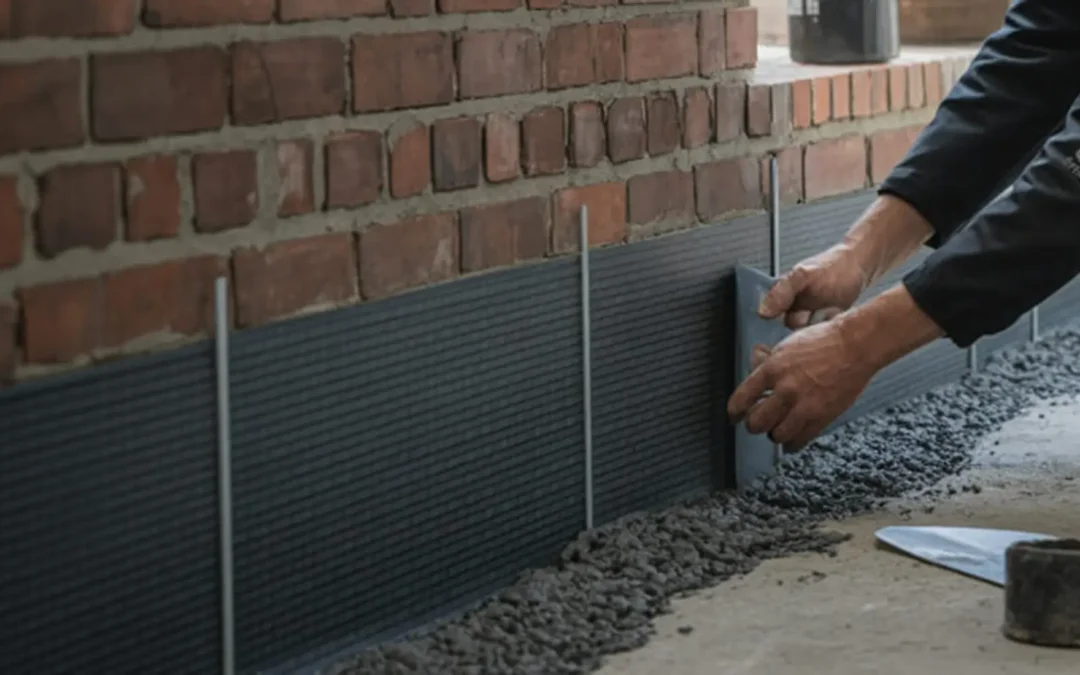
The soil around the house is excavated down to the footing. The wall is cleaned and repaired, a waterproofing membrane is applied, and often a drainage board and footing drain are installed to carry water away, to daylight or to a sump.
Strengths: keeps water out of the wall itself; addresses the problem at its source; can be combined with foundation crack repairs.
Limitations: more disruptive and usually more costly, because of excavation; patios, walkways, decks, stoops and plantings near the house may have to be removed and rebuilt.
Side-by-side comparison
| Interior system | Exterior system | |
| What it does | Collects and pumps out water that gets in | Blocks water at the outside of the wall |
| Disruption | Inside the basement only | Excavation around the house |
| Typical cost | Lower | Higher |
| Effect on landscaping | Minimal | Significant |
| Depends on a pump | Yes | Often, if drains go to a sump |
| Best for | Seepage at the wall-floor joint, rising groundwater, finished yards | Leaking walls, porous or deteriorated masonry, new construction or major renovation |
Signs that point toward interior waterproofing
- Water appears mainly where the wall meets the floor
- The problem gets worse with heavy rain or a high water table
- You have a finished patio, driveway or landscaping you don’t want to dig up
- The foundation walls themselves are in decent condition
Signs that point toward exterior waterproofing
- Water is coming through the walls, not just at the base
- Mortar joints are crumbling or the walls are visibly porous
- You’re already excavating, for example for an addition or a foundation repair
- You want the wall itself kept dry, such as before finishing a basement
In some homes, the best answer is both: exterior work on the worst walls, with an interior drain and sump as a backup.
What about sealant coatings?
Waterproof paints and coatings applied inside the basement can help with dampness. On their own, though, they rarely stop active leaks. As HGTV notes, citing building-science guidance, interior coatings work best when paired with a drainage system and sump pump.
Questions to ask any waterproofing contractor
- Where do you think the water is coming from, and why?
- Have you checked gutters, downspouts and grading?
- Does your system include a sump with an airtight lid and battery backup?
- What happens to my patio, walkway or driveway if you excavate?
- What does the warranty cover, and for how long?
A good contractor will explain their diagnosis before recommending a system.
Get an honest assessment
Shore 2 Shore Stonework & Asphalt provides basement waterproofing, foundation waterproofing and internal leak repairs across Suffolk County. Because we also build patios, walkways and driveways, we can plan exterior work and restore your hardscaping afterward. Learn more on our waterproofing services page.
Request a free estimate and we’ll inspect your basement, find the source of the water, and recommend the approach that fits your home.
FAQs
Can I finish my basement after interior waterproofing?
Often, yes, as long as the drainage membrane stays intact behind any new walls. Don’t fasten through the membrane.
Does exterior waterproofing require a permit?
Requirements vary by town in Suffolk County. Your contractor should confirm with the local building department before excavating.